About Us
21st CCLC and Extended Learning Time The purpose of the 21st CCLC Extended Learning Time (ELT) program under ESEA flexibility is to permit an eligible entity to use funds under the 21st CCLC program to provide activities that support high-quality expanded learning time (ELT) during an expanded school day, week, or year. ELT is, by definition, the time that a school district (otherwise known as a Local Education Agency or LEA) or school extends its normal school day, week, or year to provide additional instruction or educational programs for all students beyond the State-mandated requirements for the minimum number of hours in a school day, days in a school week, or weeks in a school year. All schools in the School District of Palm Beach County 21st CCLC ELT STEM iLab Projects are schools with extended leanring days.
The state required targeted populations to be exclusively composed of students who attend Title I-eligible schools that received a school grade of 'D' or 'F' in 2010-2011 or 2011-2012 and that have been mandated to provide expanded learning time by the district or state education agency.
The School District of Palm Beach County received TWO grant awards under the 21st CCLC ELT Initiative. The STEM iLab Projects (Inquiry and Investigations) were awarded April 1, 2013 and are expected to continue through the 2015-2016 academic year.
State and Federal Goals The specific purposes of the law for 21st CCLC funds are: (1) to provide opportunities for academic enrichment, including tutorial services, to help students who attend low-performing schools meet state and local academic achievement standards in core academic subjects, such as reading and mathematics; (2) to offer students a broad array of additional services, programs, and activities—such as youth development activities, drug and violence prevention programs, counseling, art, music, physical education and recreation programs, technology education programs, and character education programs—that are designed to reinforce and complement the regular academic program of participating students; and (3) to offer adult family members of students served by community learning centers opportunities for literacy and related educational development.
Program Objectives 1.1) 85% of actively participating STEM iLab students will demonstrate improved understanding and application of scientific principles consistent with Florida's Next Generation Sunshine State Standards, as demonstrated by such measures as pre-post assessments, school grades, and/or standardized test scores. (Student Science Portfolios will be maintained to demonstrate engagement in activities and projects).
1.2) 80% of actively participating STEM iLab students will demonstrate improved knowledge, skills, & abilities in mathematics consistent with Common Core Standards, as demonstrated by such measures as pre-post assessments, grades, and/or standardized test scores (when available).
1.3) 80% of actively participating STEN iLab students will demonstrate increased reading proficiency, as demonstrated by such measures as school grades, standardized test scores, and/or district assessments.
1.4) 90% of actively participating STEM iLab students will express increased understanding and interest in the STEM fields of science and engineering, as demonstrated by such measures as pre-post assessments, and/or student interest surveys.
1.5) 80% of actively participating STEM iLab students will show increased dedication, motivation, and commitment to the educational process, as demonstrated by teacher surveys on work completion and active participation and/or student surveys.
1.6) 90% of school teachers whose students participate in the STEM iLab Project will express teacher satisfaction with the 21st CCLC project and a positive impact on their ability to navigate the extended school day, as demonstrated by such measures as teacher feedback surveys and/or teacher interviews.
2.1) 70% of adult family members of STEM iLab students participating in family services will demonstrate increased involvement in their child's education, as demonstrated by such measures as participation logs and/or teacher observations. (Needs: Education Attainment; First Generation; Language Barriers)
2.2) 80% of adult family members of STEM iLab students participating in 21st CCLC family services will increase exposure and understanding of student educational resources, as demonstrated by such measures as parent surveys and/or teacher observations. (Needs: Low Education Attainment; Hard to Reach Parents; Perceived Barriers to Resources)
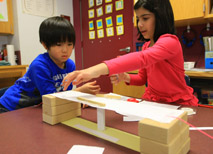
Engineering is Elementary (EiE) Engineering is Elementary (EiE): EiE will be the primary curriculum used during the STEM iLab Project-Based learning environment. Children are born engineers—they are fascinated with building, with taking things apart, and with how things work. However, K-12 educational settings have traditionally done little to develop children's engineering and technological literacy. The Engineering is Elementary (EiE) project fosters an understanding of engineering, technology, and literacy among elementary school students and educators. EiE is research-based, standards-driven, and classroom-tested curriculum that integrates engineering and technology concepts and skills with elementary science and literacy topics. EiE lessons not only promote science, technology, engineering, and mathematics (STEM) learning in grades K-5, but also connect with literacy and social studies. EiE has reached over 2.7 million students and 32,000 teachers in all fifty states. All EiE units are tested and evaluated at all stages of development, and all units are research-based where each unit is tested with a national audience, with student learning assessed using a pre- and post-assessments and compared against a matched national sample of classrooms collecting control data (e.g., Cunningham, Lachapelle & Hertel, 2012; Jocz & Lachapelle, 2012; Moffett, Weis, & Banilower, 2011).
Each EiE unit integrates an elementary science Florida State Standard with a specific field of engineering. Unit lessons are designed to engage students in the engineering design process through a variety of methods. First, literature books featuring child characters from a variety of cultures and backgrounds introduce students to an engineering problem. Student then are challenged to solve a problem similar to the one faced by the main character. In addition to providing a context, the literature also introduces engineering and technology terms, and reinforces state science benchmark vocabulary. Second, detailed unit lesson plans and teacher guides are provided that tie-in the learning objectives with science vocabulary and content. Third, multiple learning activities are provided in two versions to accommodate the cognitive and linguistic abilities of the learner: basic (lower reading level, writing, and cognitive complexity for grades K-2) and advanced (higher reading level, writing, and cognitive complexity for grades 3-5). Fourth, assessments and rubrics with multiple choice and open ended questions are provided to gage the learners understanding. Finally, background information and additional resources are provided for the teacher to further their understanding about the concepts.
A total of 12 EiE curricula units will be used within the STEM iLab Project (across three years). These units were selected to allow students to apply science knowledge in a hands-on engineering context. The following units were selected: (1) Sounds Like Fun!: Seeing Animal Sounds; (2) Catching the Wind: Designing Windmills; (3) A Long Way Down: Designing Parachutes; (4) Taking the Plunge: Designing Submersibles; (5) The Attraction is Obvious: Designing Maglev Systems; (6) A Sticky Situation: Designing Walls; (7) Now You're Cooking: Designing Solar Ovens; (8) Lighten Up: Designing Lighting Systems; (9) The Best of Bugs: Designing Hand Pollinators; (10) Solid as a Rock: Replicating an Artifact; (11) An Alarming Idea: Designing Alarm Circuits; and (12) No Bones About It: Designing Knee Braces.
STEM iLab Service Locations
21st CCLC STEM Investigations Lab
Bethune Elementary School
Belle Glade Elementary School
Pioneer Park Elementary School
West Riviera Elementary School
21st CCLC STEM Inquiry Lab
Barton Elementary School
Galaxy Elementary School
Grove Park Elementary School
Northmore Elementary School